


Data-Driven Solutions for Health & Research

I help academic research groups, biotech and pharmaceutical teams design studies, analyse data and understand their results.

My experience in experimental immunology shapes how I work with data: interpreting changes in the context of the biology, assessing alternative explanations and identifying useful follow-up experiments.

Services

Support with a defined analysis, experimental planning or ongoing research — for individual researchers and established teams.

Immunology & experimental strategyResearch questions, study design, assays and models.

Work through the biological question, refine a hypothesis and plan experiments with interpretable outcomes. I draw on experience in cancer immunology, inflammatory disease and experimental models to assess which approach makes sense for your study.

Study design · Immune phenotyping · Flow cytometry · Assay & model selection

Typical deliverables

A review of the proposed study, recommended assays and controls, key limitations and a prioritised plan for follow-up work.

More about immunology consulting
Bioinformatics & biological data analysisSequencing, flow cytometry, metabolomics, lipidomics and multi-omics.

Analyse biological datasets and interpret the findings in the context of your experiment. Work can include quality control, statistical comparisons, pathway analysis, visualisation and integration of complementary datasets where appropriate.

Bulk & single-cell RNA-seq · Spatial transcriptomics · Chromatin accessibility · Immune repertoire · Flow cytometry · Metabolomics & lipidomics

Typical deliverables

A QC assessment, agreed analyses, result tables and annotated figures, written biological interpretation and a findings discussion. Reproducible code where included in scope.

More about single-cell & multi-omics analysis
Independent analysis reviewA critical assessment of your methods, results and biological interpretation.

A fresh perspective on an existing analysis, whether produced by your team, a service provider or an AI-assisted workflow. I assess whether the methods address the question, how the experimental design affects the conclusions, and which findings need further investigation.

QC & assumptions · Statistical design · Biological interpretation · Reproducibility

Typical deliverables

A review of the supplied methods and results, an assessment of limitations, prioritised recommendations and a discussion with your team.

Ongoing research & bioinformatics supportAn external specialist working with your team as projects develop.

Work directly with me on experimental planning, new datasets and interpretation as your project develops. I can support internal scientists, provide additional analysis capacity, or work with groups that do not have an in-house bioinformatician.

Research planning · Analysis & interpretation · Pipeline development · Team handover

Typical deliverables

Agreed milestones, updated analyses and figures, interpretation and project discussions, and documented workflows where included.

Research & consulting projects

Examples of my work in research, data analysis and immunology consulting.

Current academic research

Carlo Pulitano’s group
The University of Sydney

I hold a 0.2 FTE position in Carlo Pulitano’s group alongside my consulting work. My work with the group includes analysis of transcriptomic, metabolomic and lipidomic data in the context of liver transplants.

I bring these different measurements back to the experimental question, examining changes in genes, metabolites and pathways and helping interpret what they may mean biologically.
Immunology consulting

Research-project design

I work with industry teams, providing immunology consulting to help design research projects.

My contribution is to bring an experimental immunologist’s perspective to their research planning: helping shape biological questions and the approach to investigating them.

Ad hoc research support

Support across research projects

I also take on ad hoc work across a range of projects, including with researchers at UCSF, UQ and Harvard Medical School.

This can involve a specific analysis, help interpreting results or scientific input as a project develops.

Published research example · Science Immunology, 2024

Investigating how innate lymphoid cells develop in the lung

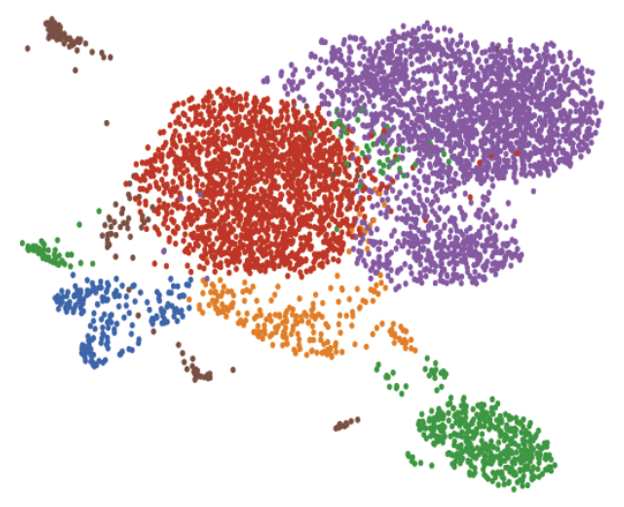
In this collaborative study, we investigated the role of the transcription factor GFI1B in the development of innate lymphoid cells (ILCs). These are tissue-associated immune cells involved in local immune responses.

What I analysed

I performed most of the bioinformatics analysis of the single-cell RNA-seq data. This included clustering and marker expression to identify cell populations, cell-cycle analysis to examine proliferative states, and RNA velocity and pseudotime to explore developmental relationships.

What the study showed

The study identified GFI1B-expressing lung progenitors with the potential to produce several ILC subsets. Loss of GFI1B disrupted particular lung ILC populations. The conclusions drew on experimental evidence as well as the sequencing analysis.

Interpreting the biology: my background in ILC biology helps me interpret which marker combinations distinguish related immune populations and how changes in gene expression relate to their development or function. I bring that immunological context to the analysis, helping the team assess plausible explanations and identify experiments that could test them.

Have a related dataset or research question?

Discuss your project

Working together

How a project works

Dataset feasibility review

A review of your research question, study design, available files and metadata, with a focused QC assessment on an agreed sample of data.

You receive

A short written assessment of what is feasible, the main limitations or missing information, recommended next steps and a discussion of the findings.

We agree the inputs, depth, timing and fixed scope in advance. A pilot analysis can then test a specific approach if useful.

Ask about a feasibility review ↗
  1. 01

    Introductory discussion

    Your question, team and timeline.

  2. 02

    Review & scope

    Available data, written scope, quote and milestones.

  3. 03

    Analysis & discussion

    Agreed work, updates and interpretation as findings develop.

  4. 04

    Delivery & handover

    Results, limitations, documentation and next steps.

Dr Sophie Curio

Dr Sophie Curio

Immunologist and bioinformatician

My background & experience ↗

I have a PhD in Immunology from Imperial College London and research experience at Harvard Medical School and The University of Queensland.

My work spans cancer immunology, inflammatory disease, experimental strategy and the analysis of sequencing, flow cytometry, metabolomic and lipidomic data.

You work directly with me, whether you need a specialist alongside your internal scientists, additional capacity for an established team, or bioinformatics expertise you don’t have in-house.

Alongside consulting through Curio Science, I am building CellScope, a separate software project focused on reproducible analysis workflows. I continue to take on consulting projects.

Connect with me on LinkedIn ↗
Research experience Imperial College London Harvard Medical School The University of Queensland The University of Sydney

Selected publications

2026 · Nature Immunology · Research

Peyer’s patch M cells organize an epithelial niche that sustains group 3 innate lymphoid cells and IL-22 ↗

Cao et al. · Co-author: Sophie Curio

2024 · Science Immunology · Research

GFI1B specifies developmental potential of innate lymphoid cell progenitors in the lungs ↗

Huang, Cao, Curio et al.

2022 · Cellular & Molecular Immunology · Review

The unique role of innate lymphoid cells in cancer and the hepatic microenvironment ↗

Curio & Belz

How I think about AI

AI in scientific analysis

I use AI regularly. It is an important part of how we work, and it is making coding and data analysis accessible to far more people.

But a script that runs, a convincing plot or a fluent explanation is not evidence that a conclusion is sound. Is the comparison appropriate? Could batch effects explain the result? Are the controls sufficient? Does the interpretation fit the biology?

That is where my expertise matters: critically evaluating the methods and findings, making uncertainty explicit, and deciding what needs to be checked experimentally. AI can help with the work; scientific judgement remains my responsibility.

Practical details

Practical arrangements

We agree the arrangements that fit your team and the project.

Confidentiality & NDAs

Let me know if an NDA is needed before sharing confidential information. We can discuss confidentiality requirements during the initial scoping conversation.

Data transfer & handling

We agree how files will be transferred, stored, accessed and retained before any project data are shared. Please describe the type of data and any restrictions in your initial enquiry, rather than sending sensitive files.

Scope & ownership of deliverables

The written scope sets out the analyses, outputs, milestones and fee. Ownership and use of results, code and any existing tools are terms to agree before the project starts. Changes to scope are discussed as they arise.

Communication & team support

You work directly with me. We agree a cadence for updates and findings discussions, whether I am supporting your scientists, providing overflow analysis or acting as your external bioinformatics specialist.

Contact

Tell me your research question, the type of data or support you need, and your preferred timeline.

A few sentences are enough. Please leave out sensitive data and confidential project details at this stage.

[email protected] ↗

I’ll reply within 1–2 business days to discuss fit, clarify the question and arrange an introductory conversation.

This form uses Formspree to send your enquiry. You can also email me directly.